• About
  • Shop
  • Galleries
  • Group Experiences
  • Travel Through Art
  • Blog
  • Contact
Menu

Cindy Harris Art

Esty Road
Bloomfield, NY, 14469
5856577080

Art that lets the light in

Cindy Harris Art

  • About
  • Shop
  • Galleries
  • Group Experiences
  • Travel Through Art
  • Blog
  • Contact

Presence and the Essentials of Now

November 14, 2017 Cindy Harris
Presence and the Essentials of Now

As a perpetual student of life and art, one of my absolute favorite things to do is witness other painters when they’re in their flow.

I’ve now seen many masters at their craft, but most recently, I saw a demo by Sara Linda Poly, the night before her fantastic workshop at this year’s Finger Lakes Plein Air Festival.

Despite her mastery, her complexity, and her skill, the thing that struck me most about her process during the demo was also the most simple: She took it slow.

From prepping her canvas to mentally measuring the light and setting her mindset to taking the first stroke, she approached everything with a certain sense that I, at first, couldn’t put my finger on.

It was presence.

At her easel, she was fully present. There was no sense of urgency, no hurried strain. She emanated calm. It’s something that’s stuck with me since.

Slowing down doesn’t come naturally for me. With light and shadows moving so quickly and so much beauty to capture whether painting en plein air or in the studio, I often feel that urgent pull in my chest to make my magic happen.

Yet here was Sara, not just in her demo, but in her workshop, encouraging us to slow down. Even though we only had two hours to paint. Even though we only had one day with her. Even though we were attempting to learn and accomplish so much.

Isn’t that always the case, though? In life, as in art, isn’t there always more to do, more to learn, more to accomplish?

Our lives will continually move ever faster and our to-do lists will grow eternally longer, which makes it more and more important to do what Sara demonstrated that day: To slow down. To focus on the present. To concentrate on the essentials of now.

This lesson came back to me when I saw the above clock at a restorative yoga class recently. I caught myself thinking about the next thing -- what was to come after class; what was waiting for me at home; what I hadn’t gotten done earlier. I refocused. I stayed present. It was a breath of fresh air; a sigh of relief.

For me, embracing the essentials of now means being fully aware of where I am in each moment -- appreciating the smells, the sounds, the scenes, the people around me. It means focused attention. It means taking the time to get into my state of flow, knowing that while there’s always more, it’s the now that matters most.

Still, slowness doesn’t come naturally to me. Presence is a perpetual practice, that will never be perfect. But it’s worth putting the work in for, don’t you agree?

Comment

The Danger of Enough (And The Parable of the Mexican Fisherman)

September 12, 2017 Cindy Harris
Cindy Harris Art - Mexican Fisherman Parable.jpg

Summer’s coming to a close. The days are getting shorter. The winds are picking up, knocking the red and gold leaves from the trees.

It’s a magical time of year, but one that also causes quite a bit of angst amongst those of us who are especially conscious of our calendars. After all, come October 1st, we’ll have just about 90 days left in the year.

In our best state, we’ll look at it as motivation: Imagine what I can accomplish in this last quarter! I’m going to do it all!

In our stressed state, we’ll look at it with fear: There’s still so much to be done! I haven’t done enough!

It’s in times like these -- when we want it all; when we want to do it all; when we want to be it all -- that the definition of “enough” seems to keep expanding, to an insatiable place that’s impossible to fulfill.

When I find myself detrimentally expanding what “enough” looks like for me, I like to re-read The Parable of the Mexican Fisherman:

An American investment banker was at the pier of a small coastal Mexican village when a small boat with just one fisherman docked. Inside the small boat were several large yellowfin tuna. The American complimented the Mexican on the quality of his fish and asked how long it took to catch them.

The Mexican replied, “only a little while.”

The American then asked why didn’t he stay out longer and catch more fish?

The Mexican said he had enough to support his family’s immediate needs.

The American then asked, “but what do you do with the rest of your time?”

The Mexican fisherman said, “I sleep late, fish a little, play with my children, take siestas with my wife, Maria, and stroll into the village each evening where I sip wine, and play guitar with my amigos. I have a full and busy life.”

The American scoffed. “I have an MBA from Harvard, and can help you,” he said. “You should spend more time fishing, and with the proceeds, buy a bigger boat. With the proceeds from the bigger boat, you could buy several boats, and eventually you would have a fleet of fishing boats. Instead of selling your catch to a middleman, you could sell directly to the processor, eventually opening up your own cannery. You could control the product, processing, and distribution,” he said. “Of course, you would need to leave this small coastal fishing village and move to Mexico City, then Los Angeles, and eventually to New York City, where you will run your expanding enterprise.”

The Mexican fisherman asked, “But, how long will this all take?”

To which the American replied, “Oh, 15 to 20 years or so.”

“But what then?” asked the Mexican.

The American laughed and said, “That’s the best part. When the time was right, you would announce an IPO, and sell your company stock to the public and become very rich. You would make millions!”

“Millions – then what?” 

The American said, “Then you could retire. Move to a small coastal fishing village where you could sleep late, fish a little, play with your kids, take siestas with your wife, and stroll to the village in the evenings where you could sip wine and play guitar with your amigos.”

Friends: Carry this with you as you embark upon the rest of this year. Consider what fulfillment really looks like for you; what really matters. Define your “enough” with caution. Then, get to work making it happen.

Comment

Painting En Plein Air: Are Your Trees Dancing?

August 15, 2017 Cindy Harris
En Plein Air Trees Dancing

As part of this summer’s Finger Lakes Plein Air Festival, I had the honor of attending a workshop from Sara Linda Poly, an artist I sincerely admire.

In her workshop, she asked us something that I’ll carry with me forever: 

Are your trees dancing?

It was one simple question that suddenly gave my entire subject matter a new life and energy; a brilliance and vibrance. Having painted en plein air for many years now, I thought I knew what it was to take in my surroundings; to see the light; to capture the scene.

But were my trees dancing? 

What I hadn’t fully, consciously realized, was that in painting en plein air, we are capturing more than just scenery and light -- we’re capturing life and the energy that gives substance to even that which is inanimate.

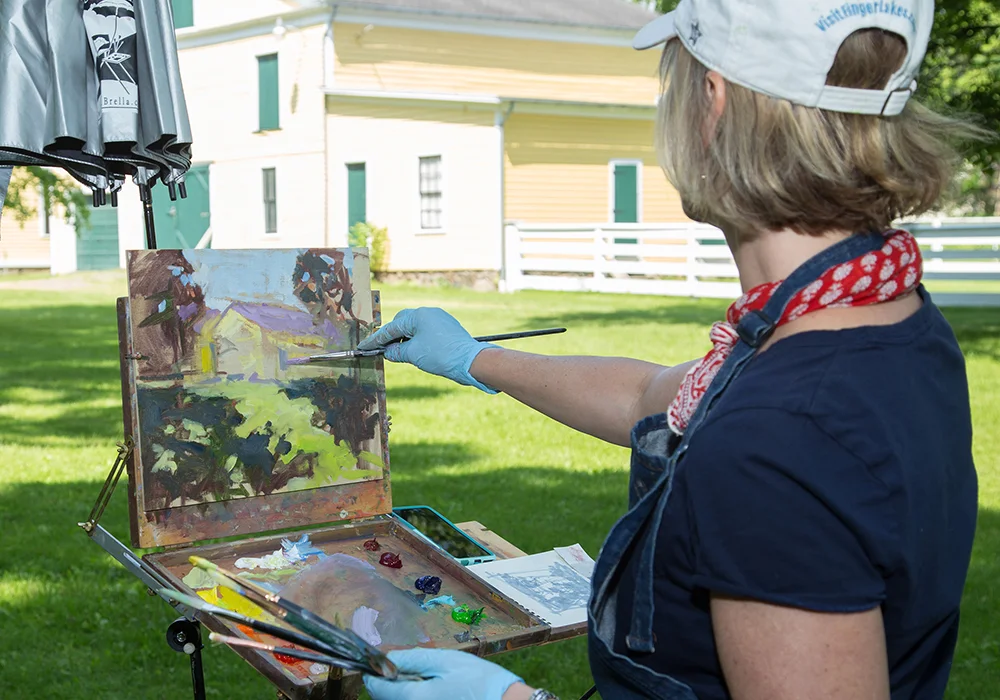
Sara challenged us that day with a project: Armed with only a palette knife, we had a small painting with five areas to focus on, and just 50 strokes to give it. It was a challenge that I took on with excitement. 

Here I was, energized by the boost I’d received after winning an award during the Community Paint Out the day before, and with new inspiration from Sara to make my landscape dance.

I gave the project my all, using broad swashes of color to make the most of my 50 strokes. It was exhilarating. Inspiring. Curiosity-inducing. Expressive and experimental, at the same time.

I went on to explore the rest of my painting that week with a childlike exploration I hadn’t experienced since I was young, and a freedom I hadn’t felt since I was a high school student with so many unmarked avenues ahead of me. 

My paintings that week are some of my best. They’re infused with life, with energy, with a brilliance and vibrancy I didn’t realize was missing before. They’re encouraged by years of learning; of filling my technical toolbelt. They’re energized by decades of witnessing; of taking in the beautiful, curious world around me.

It’s taken years and years to find this place -- a place informed with not just technical training, but childlike exploration. A place that truly invites life into painting. A place that makes trees dance.

1 Comment

Everything You Need: Internal & External Validation as an Artist

July 13, 2017 Cindy Harris
Internal and External Validation as an Artist

It’s warm. The sun is making its way up toward noontime, but it still has a way to go. There’s a slight breeze, and the light is rendered nicely off the trees as they sway.

Easel? Check.

Brushes? Check.

Stamped canvas? Check. 

I have everything I need on me as I make my way to the perfect spot: the carriage barns at Granger Homestead. They’re tucked into a back corner of the property, and there’s a dappling light in the front that I can’t wait to capture.

I have only minutes to get my easel set up once I’ve found my spot. Two hours to paint. One chance to get it right.

I know that the clock is ticking. I’m aware that others are seeing this same magnificent light. I can anticipate the judges’ critical eyes on my piece when all is said and done.

And yet, I’m here. I’m present. I’ve spent years exploring my style and honing my skill in preparation for moments like these. I’m owning it. 

I paint with color; with light; with vibrance. Even with just two hours, I’m able to dive fully into the moment and my surroundings, slowing down and taking the time to let the scene lay itself out onto the canvas with my brush and hand as the vehicle.  

The clock ticks down; it’s time to wrap. I have half an hour to frame my piece, price it, and take it to the judging station, at which point the judges will decide their winners as we artists reconvene excitedly.

It’s the Community Paint Out at this year’s Finger Lakes Plein Air Festival, and I’m one of those artists, waiting excitedly -- though not expectantly.

Needless to say, I’m thrilled when I hear my painting has won an award.

My piece. Not my best piece, but a piece I feel good about hanging. A piece I had very little time to explore yet, at the same time, everything I needed to get right. It earned an Honorable Mention, hanging amongst the winners with a ribbon on it.

I’ve entered contests before. I’ve felt my self-esteem ride the roller coaster of ups-and-downs that come with recognition and rejection. But I’ve never felt the spark that came with this level of validation amongst a varied, experienced, and well-traveled group of painters and judges.

I, perhaps like you, have been quiet about seeking other’s validation. It feels negative; greedy; unnecessary. Yet striking a blend of internal and external validation as we learn and grow can be a strong source of inspiration and motivation to keep leaving our mark on this world.

On the easel that day, I’d experienced true internal validation. I felt the years of hard work and learning ease my mind and flow naturally from my brush. Later, in front of my fellow artists and the panel of judges, I felt recognition that gave a new level of meaning to the inner work that’s been done.

Paint for yourself. Write for yourself. Create for yourself. Slow down. Learn. Be present. And when the time is right? Don’t be afraid to seek validation, gratification, or appreciation from others. Much as we might try, our fires simply can’t stay lit on their own -- and that’s okay, because our need for each other is what makes this world go around.

Comment

The Courage of Conviction in Art & Life

June 13, 2017 Cindy Harris
Georgia O'Keeffe Brooklyn Museum

I’ve appreciated many, many people throughout my life. From the strong characters I’ve known personally to the women of history I’ve admired for their work abolishing slavery, establishing the right to vote, and spreading peace, I’ve been personally blessed to have more people than I can count to light my path.

There’s one thing these women have had in common that has made them unquestionably brave: Conviction.

Their steadfast beliefs have guided their actions -- not eliminating fear, but overcoming it. Not erasing vulnerability, but embracing it.  

Georgia O’Keeffe is yet another luminescent example of such a woman. I was reminded of this as I strolled the “Georgia O’Keeffe: Living Modern” exhibit at the Brooklyn Museum in May.

Ms. O’Keeffe was thoughtful and intentional in everything she did, from the clothes she wore to the places she lived. Though much of her success was a result of surrounding herself with the right people, it was her conviction in her own personal life that sustained her success; her vitality; her mindfulness.

She had the conviction to live where she wanted. She picked up and moved to Sante Fe to dig into her work and embrace the abstract.

She had the conviction to do one of the toughest jobs -- make a living from her art, working as an art teacher early on and selling posters to pay the bills.

She had the conviction to choose simplicity in an era of decoration. She had what she needed -- and those things were of high quality -- but she was deliberate and intentional with that which she curated, choosing simple palettes of black and white and forgoing makeup.

She had the conviction to set herself apart with her art -- her bold use of color; her deeply in-touch nature with her surroundings; the depth with which she captured inanimate objects, giving them life.

Conviction is not without choice. And choice is not without courage. Georgia O’Keeffe’s life was a series of courageous choices led by her intense conviction.

Our yearnings can be satisfied with conviction. But we must make choices. We must be courageous. We must determine how we want to live -- what that looks like -- and then take the actions to make it happen. We must surround ourselves with the right people. We must, ultimately, know and trust ourselves.

Comment

Creatives: Growth Requires Vulnerability

May 18, 2017 Cindy Harris
Creative Growth Requires Vulnerability

When it comes to painting -- or expressing your creativity in whatever way you choose -- I’ve talked many times about finding your tribe, about declaring your space and dedicating time to making it happen, and about putting your soul on display by exhibiting your work.

The reason I risk being a broken record when it comes to connecting with people, making and keeping promises to actually create, and putting yourself out there as an artist is because it is incredibly hard to do.

The greatest challenge in each of these things is the vulnerability they each require. Finding your tribe requires genuine connection with others. Declaring your space and dedicating time to make creativity happen requires a sometimes uncomfortable commitment to yourself. Exhibiting your work requires the courage to know you can’t please everyone.

What do all of these things have in common? They push us to expose our vulnerabilities.

By nature, we’re all averse to vulnerability, but I’m here to tell you this: Vulnerability is perhaps the most necessary requirement to actually growing as an artist or creative.

From the very first day I wandered into Pat Rini Rohrer’s Gallery on Main Street in Canandaigua more than 10 years ago, my vulnerability took center stage -- and the fear that came with it slowly receded.

That gradual recession of fear improves each week, when we close out our Wednesday night painting classes with a round of critiques.

During these group critiques, we all share positives and areas of improvement for each other’s work. It’s simple on the surface, but so much goes into these critiques. First, we must be okay with emptying our soul onto the canvas. Then, we must allow others to not only witness it, but to share their opinion on it.

This can amplify our fear; solidify our desire to keep our work inside. But what we must realize is this: If we hide our work from the world, we’re depriving it of its chance to be seen; to be improved; to grow.

Group critiques have always felt natural for me in this space, as I’m surrounded by people I love. Overcoming the fear associated with vulnerability becomes exponentially easier when you create consistency, build trust, and recognize the healing and rejuvenation that can come from allowing yourself to be vulnerable.

This showing of vulnerability within the cooperative space at Pat Rini Rohrer’s has not only been crucial for my own growth in skills and development of where I want to go with my art; it’s also opened so many doors for me. It’s bonded me with a tribe of incredible women. It’s introduced me to the teachings of Pat as well as others, like Lori Putnam. It’s given me the courage to apply for and enter my paintings in shows like the Plein Air Festival. It’s encouraged my travel to places like Monhegan Island and the south of France.

When we acknowledge the role of vulnerability in our growth as artists and creatives, amazing things happen.

We find our tribe. We make art a priority. We grow.

Actively seeking feedback on your work is just one way to overcome vulnerability in the name of growth. I want to hear from you: How else do you overcome fear and accept vulnerability -- and how does your art thrive as a result?

1 Comment

Declaring Your Sacred Space + Time for Art

April 21, 2017 Cindy Harris
Declaring time and space for art

Last month, I dispelled the myth that art is selfish and urged you to share your creativity with the world. It bears repeating: Art is generosity. Creativity is a gift. The only selfish act is in keeping it to yourself.

Changing your mindset around art and creativity is the first step to giving it the attention it deserves. The next (crucial) step is keeping a promise to yourself and making the space and time to actually create.

Personally, my biggest barrier to actually being a painter has always been a feeling of obligation; of responsibility. To others; to my home; to my career. With all that weighing in, it’s no surprise that I went years without putting painting in the forefront.

As parents, siblings, children, employees, and general human beings, it’s all too easy to shelve our creativity as we consistently put others’ needs in front of our own.

My life changed the day I realized how imperative it is to make painting -- my form of creativity; my healing, light, and gift -- its own obligation and to give it the space and time it deserves. It’s a change I want you to experience for yourself.

How I found my sacred space

It started when my son Bryan, the younger of my two children, left for college. I was walking around Canandaigua and wandered into an art gallery.

As I explored the gallery, my thoughts turned quickly from “What will I do with life now that I don’t have basketball or baseball games to attend?” to “How can I explore this world of art I’ve neglected for far too long?”

The gallery I’d wandered into was owned by Pat Rini Rohrer, a local Finger Lakes artist. I’d known her previously from a cooperative gallery we both took part in, but she approached me that day and encouraged me to take a class. Her encouragement started there, and never stopped.

I started taking an oil class, fell in love immediately…and never left. Pat was the angel that appeared at exactly the right time, when thoughts of actually making time to create had been buried for so long that I wasn’t sure they’d be able to dig themselves out.

Honoring my promise

For the last 10 years now, my Wednesday night class at the Pat Rini Rohrer Gallery on Main Street in Canandaigua has been my staple; my sanctuary; my way of keeping that promise to myself. It’s my time to surround myself with my tribe -- ladies who know the elation, the internal rejection, the pride, and judgment, and the overall passion that goes into expressing creativity.

All of my people -- the people I previously let my self-induced feeling of obligation to hinder my painting -- know that Wednesday nights are my night. They honor it. I honor it. I not only look forward to Wednesday nights with a burning excitement; I leave Pat’s classes energized, excited, and full of spirit and life. That gratitude carries me through each and every day in between.

Make time for your art

Brené Brown said: “Creativity is the way I share my soul with the world.” What I’d like to add: If we store that creativity up inside us for too long, our soul cannot be rejuvenated.

Carve out time and make space for your creativity.

Maybe it’s 20 minutes per day. Or one night per week. Or a full week every few months.

Whatever it is -- it’s crucial that you not only work time into your undoubtedly busy schedule to create, but that you keep a promise to yourself and actually make it happen.

Comment

The World Deserves Your Creativity

March 21, 2017 Cindy Harris
2017_03 The World Deserves Your Creativity.jpg

Making art is a deeply personal affair. Putting our soul on display by giving a voice to our creativity can put us at our most vulnerable, and vulnerability never fails to inspire fear, often stopping us dead in our tracks.

Likewise, I know of far too many artists and other creatives who view their work as self-serving, often tabling it in favor of other “obligations” -- family, friends, pets, bosses, colleagues...anyone but themselves.

I did this, putting my creativity on the backburner and neglecting my pull to paint, for far too long. Entire years went by without a brushstroke to be had, and dreams of spending weeks upon weeks in the European countryside and running my own artist retreats were abandoned in the name of responsibility, mostly to others.

Now, please don’t misunderstand: The people in my life are very important to me. My kids are my everything; my husband is my ultimate partner. My family, friends, and pets hold a very high regard in my life, and I know I’d be lost without them. I have no doubt you have those people and responsibilities that you’d never give up, as well.

But the mistake we make is in thinking that creativity and responsibility are mutually exclusive. If we are putting our creativity to work -- actually creating, that is -- we must not be responsible, right? If we are fulfilling our own creative desires and doing the work that is deeply personal to us, we must be neglecting the other people and things that need our attention, mustn't we?

This is where I beg you to pause. To pull back for a minute. To join me in a very important realization that changed the way I create and put painting back in the forefront of my life:

The world deserves your creativity.

Your creativity, while deeply personal, is not selfish. Your creativity, when expressed and shared, is something the world can experience. Bear with me here, my fellow former martyr:

First, your creative work has the potential to change a life. A simple interaction with a painting, a novel, a sculpture, a textile -- no matter the medium -- can have an unforeseen effect in the most unlikely of places, and when we least expect it.

Second, your creative work has the potential to change your life. Since I’ve made painting a prominent part of my life, and stopped putting my dreams on the backburner, I’ve become a better person. A more patient person. A more generous person. A more joyful person. That, my friends, is doing the world a favor.

Art is generosity. Creativity is a gift. The only selfish act is in keeping it to yourself.

Comment

Letting Stillness Speak (Overcoming Fear and Ego in Painting)

February 21, 2017 Cindy Harris
Letting stillness speak in painting

Last month, I shared a French phrase that has been guiding my paintings since I returned from my fall 2016 trip to Limoux: Pas de peur; pas d’égo. No fear; no ego. It is the way I wish to create and what I wish for all creatives, everywhere: That we can let go of the stumbling blocks of fear and overcome the hindrance of ego as we bring our work to life on whatever our canvas might be.

Letting go of fear hasn’t always been easy for me. And until recently, I didn’t realize that ego was such a barrier, either. For far too long, I’ve let that voice in the back of my head grab the microphone and project its doubts and shame: Will anyone even like this? Why are you trying so hard? Who do you think you are?

That voice is fear. It’s the questions of whether I’ll fail; of whether I’m good enough. That voice is also ego. It’s the questions of whether anyone else will like it; of whether I’ll be accepted.

Of course, as an artist, it’s tough to separate ourselves from our work, which is what makes fear and ego so hard to overcome. Yet as I’ve spent more time with my paintbrush in hand over the last few years, I’ve found the answer to fear and ego. Actually, I can’t quite say I found it...it was there all along.

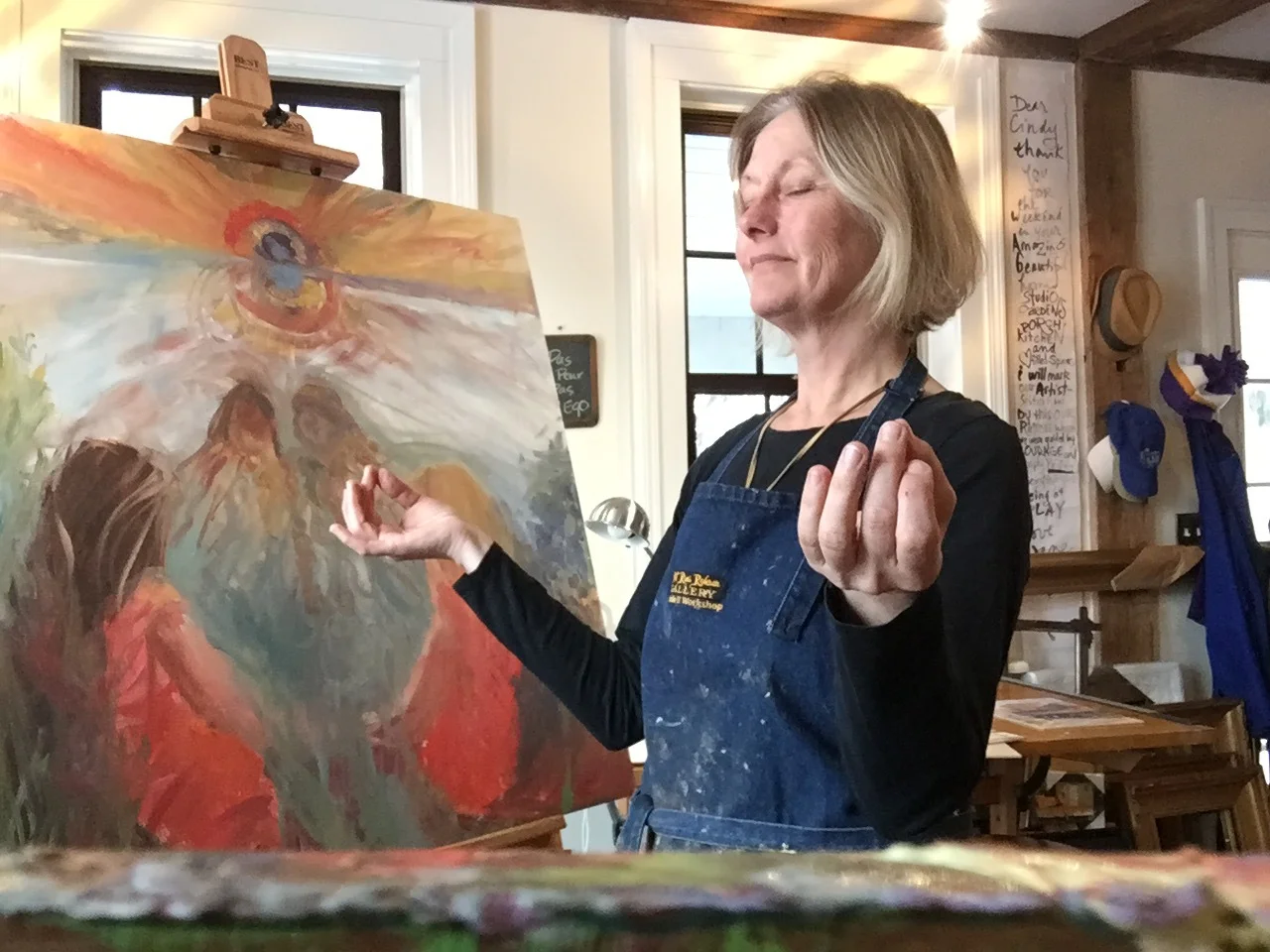
It’s the appreciation of painting as my meditation. The act of meditation -- spending time in quiet thought -- often evokes images of people cross-legged on comfortable rugs, with candles burning. And while I’m also fully onboard with cozy meditation corners, I find that my most meditative state comes in front of an easel, with a palette of colors and the light shining on the scene in front of me.

It’s during this time that I see and feel deeper than anywhere else in my life.

As Eckhart Tolle describes, it’s also during this time that “the stillness speaks to me.”

The scenes, the objects, the light -- it speaks to me as I paint. It’s what gives me the ability to look deeply into something as “simple” as a flower and feel the energy it has; to become part of it.

This meditative state is what makes painting such a spiritual practice for me.

But, most importantly, it’s a place where fear and ego aren’t welcome. It’s a place where my surroundings speak to me, drowning out any doubts, and all voices of fear and ego. It’s a deep, deep place I want to invite all creatives into, and a place I never want to leave.

Comment

Sketches As Time Capsules: An Age-Old Approach to Plein Air

January 25, 2017 Cindy Harris
plein air sketches

Just a few months ago, I was standing at an easel on a sunny day in Limoux, France, studying an old French villa with an orange tree outside of it. I could picture myself within the walls of the villa. I could smell the vivid scent of the oranges adorning the tree. I could feel my skin soaking up the warm September sunlight.

I had only a brief time at that easel; hardly enough time for the full scale painting I wanted to create of this magical scene. So I grabbed an 8x10” board and sketched the scene with my paints, not worrying about perfection nearly as much as the encapsulation of the senses that were stimulated by what I was seeing: the colors; the light; the details of the walls.

I was doing what many an artist from Leonardo to Sorolla has done before me: Using my time spent en plein air to capture quick studies that will later inform my studio paintings.

The goal in these “sketches” isn’t mastery. It’s memory. It’s capturing the cues that will spark recognition when we’re far from France, or whatever pocket of the world you’d like to be transported to at any given time.

Don’t get me wrong; I’ve painted from photographs before -- and I still capture photos to complement the sketches I’m creating en plein air. But painting from a painting doesn’t just give me something to look at that reminds me of time spent in a particular place; it gives me the internal pictures, the scents, and the feelings that went along with being there.

Sketches as a time capsule

With quick sketches from nearly each place I visited in France, I can now take a journey from the warmth of my home studio on the cold, blustery, and snowy winter days in the Finger Lakes of New York at any time I choose. I can immediately be transported back underneath that bridge in Limoux or in a garden with orange fruit growing. I’ve captured the colors, the reference points, and the feelings that will allow me to return to that place and create the work I didn’t have time to do while actually on the spot.

Like a writer leaving off mid-sentence, creating these sketches gives me a natural starting point to pick up right where I left off, in a world very different than the one I might be standing in in the present moment.

Pas de peur; pas d’égo

I’ve got a new series going now based on my plein air sketches from France, and I’m excited for what this process of sketching might allow for future work -- but most importantly, I’m incredibly fulfilled by the fact that in this moment, I’m painting to paint. I’m not painting for approval. I’m taking on the true French way of being: Pas de peur; pas d’égo. No fear; no ego.


The voice in the back of my head -- the one asking, “Is anyone else going to like this?” -- is silenced. With my sketches and memories in hand, I can create paintings that express themselves without fear; without ego. The way true art is meant to be created; the way I hope all artists learn to live.

Comment

Projects and Persistence in Painting

December 20, 2016 Cindy Harris
12 drummers drumming painting


Twelve years ago, I started a project whose seeds were embedded well before I ever put paintbrush to canvas.


It started when my kids were little. Each and every year around this time, just as the snowfall becomes more regular and the smell of pine becomes more prominent, I’d cozy up with my kids to read the 12 Days of Christmas. 


Of course, reading the book always meant singing the song, and before we knew it, it became a family tradition to make the 12 Days of Christmas a regular part of our holiday celebrations. 


For me, I first fell in love because of the family gathering it inspired, but that love grew deeper when I really took time to explore the different ways the 12 Days were illustrated, and the meanings behind them. Of course, with a song and story that has centuries of history behind it, it’s bound to be disputed -- but that aura of mystery that inspires so many different interpretations is one of the things I love about it.


As with most things I love in life, I began to brainstorm how I might incorporate the 12 Days of Christmas into my painting practice. What evolved was more than I could’ve originally imagined.


The 12 Years of Christmas


In the initial year, I took the first verse... 


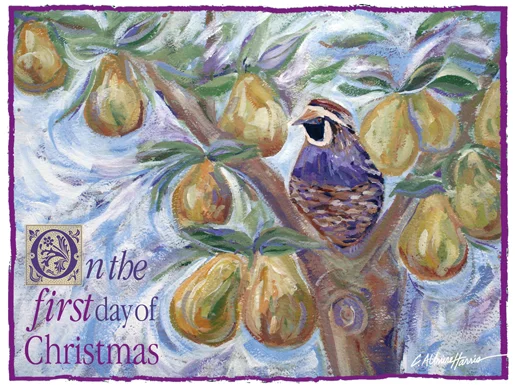
“On the first day of Christmas, my true love gave to me, a partridge in a pear tree.”


...and I painted my version of it. 

Partridge In a Pear Tree painting

That painting became my Harris Studios holiday card for the year. As soon as I was finished, I started brainstorming what next year’s, those two turtle doves, would look like. Needless to say, I was quickly committed to a 12-year project.


Making it mine


Despite it being a painting that I would normally only tackle around November or December, this project tended to stay on my mind all year long. As a result, each year’s painting (and therefore holiday card) reflected my interpretation of that year’s verse, much inspired by what was going on in my life, my business, or the world at that time. 


This year’s painting is no different. As I approached the final year of the project -- 12 drummers drumming -- I couldn’t help but think of the divided nature of today’s society; the negativity that’s been prevalent in much of this year’s news; the easy way in which we’ve forgotten all the light in the midst of all the dark.


It led to one of my most important paintings (above) and messages yet: 


“Listen for the beat, the blending of our spirits. For we’re all in this together. Find the similarities. Celebrate the differences. This season, let’s send joy to the world as we take time to center ourselves and to help others find peace and love.” 


Practicing persistence in a prolonged painting project


I’m incredibly proud of what this series has become, but that’s not to say that it’s been easy. Any prolonged project requires a certain air of persistence and self-determination, and this was no different.


I had to overcome the lure of distractions by remembering that other projects could be pursued both around this one and after it’s complete.


I had to overcome the itch to skip a year when it just felt like it was too much by remembering all those who’ve told me that they save my cards year after year and couldn’t wait for the next one.


I had to push past the inner naysayer who liked to creep up and tell me that this didn’t matter by having a constant reminder at-the-ready: That there’s the surface value of having a painting painted, but the internal work and meaning behind it is what matters, always.


Prolonged persistence is a true test for anyone, anywhere -- but especially for creatives who love to dream.


But like any project that you’re proud of and that stands to help others: It’s completely worth it.


Ready for what’s next


Coming to the end of such a deep project feels a lot to me like finishing a good book that you’ve found yourself very involved in. There’s that initial feeling of overwhelm at what’s next. Then there’s the time to reflect on what you’ve just taken in. Then, there’s the excitement of what’s next. 


Because we’re always moving forward, friends.  

Comment

The Grace of Letting Go

November 29, 2016 Cindy Harris
Letting Go at the Dove of Minerve

Prior to embarking on a cross-Atlantic painting journey this fall, I wrote myself a letter.

It was a letter I needed to write; a letter that no one ever needed to read.

It expressed my fears, acknowledged my shame, and brought tears to my eyes both as a I wrote it, and each and every time I read it thereafter.

This trip, you see, was a lifelong dream of mine. A chance to say yes in a way I’ve never said yes before, and a way to step past the fear, shame, and guilt that has so often plagued me in my painting, in my business, and in my life.

Little did I know, this letter would change not just my outcome of the trip, but the outcome for the other ladies journeying with me.

Opening up

At our very first gathering upon arriving in Limoux, a small, picturesque city in Southern France, our leader, artist and teacher Lori Putnam, asked us a simple question:

Why are you here?

One might expect answers like, “I want to learn more about painting” or “I’ve always wanted to travel to France.” Perfectly fine reasons. But this crowd? This crowd immediately opened up.

Ladies shared the motivations behind saying yes to this trip, with many of us nodding along, happy to be on this journey with others who understood. Then came my turn. I took a deep breath, and shared that I was here on a personal journey -- a journey to break the chains of shame and guilt and let go of the weight they bore on me.

I heard a resounding “me, too” from so many ladies at the table. Uncharacteristically, I asked them if they’d like to join me a few days later, at a ceremony I’d crafted prior to arriving. The answer? Yet another yes.

Speaking your truth

The ceremony I’d designed included traveling to a special place: the Dove of Minerve, a carved stone representing the crusades of the early 1200s where many Cathar women were burned alive. I would take a lock I’d brought and lock it to the fence there, leaving my heaviness in a place where many others left theirs.

This wasn’t any old lock. It was heavy; tarnished; beautiful. It was a lock I sought out for quite some time prior to my trip -- the perfect representation of the heavy, somewhat tarnished, yet oddly beautiful experiences I was looking to leave behind.

The day of the ceremony, we arrived at the fence, I took the letter out, and I spoke it.

My words represented my journey -- they showed gratitude for the darkness; said thank you for what it has taught me along the way.

I acknowledged the hold that shame and guilt had had on me for decades, and voluntarily (and adamantly) released it.

I had never imagined reading this letter out loud. When I did, I stepped outside my body, in sudden observance of the angels surrounding me.

I was a messenger. I am a messenger. We are all messengers.

Healing together

Showing gratitude for the darkness lets me fully embrace the light. There is new and true healing in my art now that I can completely let that light in.

Artists, by nature, are healers. Yet it’s not until we let go of the darkness and experience feelings of lightness, courage, and freedom -- through our words; our painting; our gratitude -- that we can help others express themselves, too.

I left things -- intangibles -- behind in the town of Minerve that were holding me back, keeping me down. Letting go of the shame and guilt I’ve known nearly my entire existence has left me feeling lighter; ready to take flight and soar higher than ever before. And ready to help others do the same.

Letting go opens up a world of possibilities of what we can do; where we can go. We just have to be ready.

I am ready. We are all ready.

1 Comment

Painting Breakthroughs in the South of France: A Full-Immersion Experience with Lori Putnam

November 1, 2016 Cindy Harris
Cindy Harris and Lori Putnam South of France

Have you ever had an experience that you look back on and say—without even a pause—that was life-changing?

Have you ever had an interaction where you walk away and think—without a doubt—that has transformed me?

Have you ever jumped on an opportunity—perhaps with some hesitation—then thought, I can’t believe that happened, but I’m so glad it did?

Pardon my vague introduction and the somewhat intense questioning, but I truly believe we’ve all had all of the above—the experiences, the conversations, and the opportunities. Fortunately, I was blessed to have them all at once, on a two-week trip to Southern France this fall.

Realizing a lifelong dream

Let’s rewind: At the beginning of 2016, an opportunity presented itself to me. It was a 10-day workshop with Lori Putnam, taking place in Limoux, France—and it was the last one she’d be running in France in the foreseeable future.

Two weeks away from work, focused entirely on painting? This was an idea that I’d only truly allowed in my innermost dreams. I couldn’t really drop my design work for two weeks. I couldn’t really leave the iPad at home. I couldn't really spend that much money on painting.

You know where this is going: Of course I could. I quieted that inner naysayer real quick (not without a fight, of course)—and booked the trip.

Becoming a magician

This trip was an experience, an interaction, and an opportunity that was life-changing, transformative, and incredibly gratifying in so, so many ways. I’ll be writing about the grace of letting go next month, but the first thing I have to talk about is the absolute transformation I’ve seen in my painting.

Naturally, being in one of the most beautiful places in the world for an extended period of time focused on finding niches and nooks to paint is going to be somewhat transformative when it comes to technique and skill. But doing it under the leadership of a seasoned plein air painter, Lori Putnam, and amongst a group of passionate collaborators made it even more so.

Here’s how I was able to learn and grow in my painting at a deeper level than ever before:

  • Accepting + capturing the light: I grew a much deeper understanding of light and value—and how to incorporate it into my work. I’ve never felt so able to take the light in, and to reflect it back. The difference is noticeable in my paintings from day 1 to day 10.

  • Appreciating fresh eyes + unfamiliar territory: Instead of being overwhelmed by the newness of each place we were in, I learned to practice gratitude for the fresh perspectives and lack of familiarity of a space. It led me to be more in tune with its unique characteristics, from the sights to the smells to the sounds—but most importantly, to the colors and the depths and the light.

  • Eliminating all distractions: For this trip, I stepped entirely away from design—I didn’t travel with my laptop or my iPad. Never before have I turned off work so entirely, but doing so allowed me to make the absolute most of every minute.

  • Capitalizing on community. A solo painting trip would be enlightening, no doubt—but being surrounded by 10 women who were not only there to grow as painters, but as people, was beyond inspiring. In our short time together, we formed unbreakable bonds that will have us growing together for eternity.

During one of our sessions, Lori declared us all to be magicians. The way we capture light; the way we embody a scene; the way we mix until the color is just right.

Never before have I felt such a sacred power—and never before have I appreciated the magnitude of this magic we create.

Breakthroughs + gratitude

In the weeks since I’ve been back, I’ve wondered,

“What if I hadn’t said ‘yes’ to this trip?”

“What if I hadn’t given myself the gift of getting away from it all?”

“What if I hadn’t shown up—really, truly shown up—as myself?”

The me of 10 years ago wouldn’t have been able to ask myself these questions—because I wouldn’t have said ‘yes.’ I wouldn’t have given myself this gift. I wouldn’t have shown up as my truest self.

Which is to say this: Slow down. You are worth the time away. You have so much to learn; to see; to do. Your art will be better for it. Your relationships will be better for it. You will be better for it.

Your turn: How are you saying ‘yes’ in your art + life?

1 Comment

My Version of Wild: What's Essential in My Plein Air Travels

September 22, 2016 Cindy Harris

A few years ago, I read Cheryl Strayed’s Wild. If you aren’t familiar, it’s a telling of her journey hiking the Pacific Crest Trail solo after a few major turns in her life. It shows her at her best and at her worst, but most of all? It shows her accepting the adventure and learning from every minute of it.

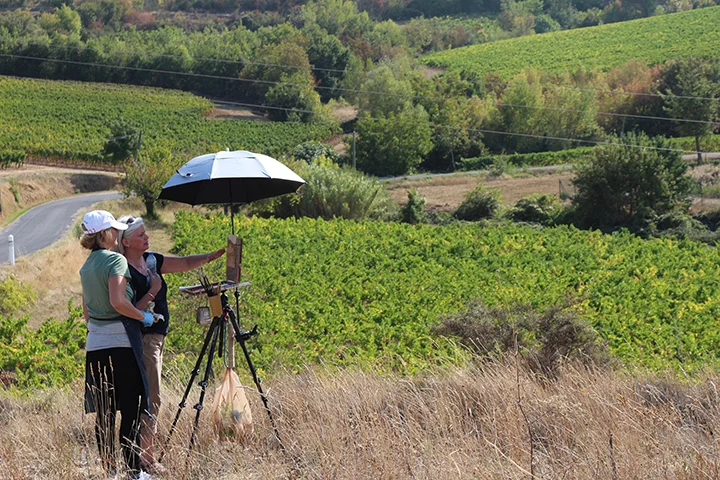
I’m about to set off on my own version of Wild -- two weeks of uninterrupted painting en plein air, in one of the most beautiful places in the world: Limoux, France, in the Languedoc region.

As I prepare to hit the road, I can’t help but think of the first time Cheryl set foot on the trail, with her monster backpack full of things she’d later discard as she prioritized the essentials and ditched the rest to ease her load.

As a painter, it’s easy to collect supplies within our studios. Piles of canvases; cases of brushes; palette upon palette of paint. Over the years, I’ve stocked up more supplies than I could ever use in this lifetime, picking up pointers from other artists, learning about new materials in seminars, and discovering must-haves in workshops.

Art supplies are, in general, an artist’s weakness -- mine, for sure. All is well and good when I’m set up in my studio. But when I started painting en plein air, I realized the need to only travel with the best of the best -- after all, my supplies had to be portable, light, and readily transportable into the woods, or down to the lake.

Now, as I prepare to leave for France, I have to evaluate my supplies even further. I’ll be traveling light -- with only the essentials -- and I thought it might help to share what those essentials are for me:

  • My pack: a Kelty Redwing 2650. It used to be my son, Bryan’s, for a father-son hiking/fishing trip. It’s special to me as I remember him upon their return, bug bitten and hungry.

  • My mini sketch pad and markers, along with this viewfinder to help create some thumbnails as I lay out my design.

  • My easel: an Open Box M 11x14 that I’m in love with, with an easel umbrella to provide shade. I used to use a heavier French easel, but this one makes travel so much easier.

  • My tripod: a Manfrotto that makes setup easy and never makes me worry about stability.

  • My paints: Gamblin Artists Oil Colors, with a limited palette learned from Lori Putnam’s color harmony workshop -- including Cadmium Yellow, Ultramarine Blue, Napthol Red, and Titanium White. (Sometimes I add an orange, violet, and green.) I pair them all with Gamblin’s Solvent-Free Gel.

  • My brushes: Lori also introduced me to Rosemary Brushes, which I continue to experiment with. I store them in a canvas brush holder I love, that took years to find.

  • My brush holder: a stainless steel holder to hang on my Open Box M that connects with my brush washer.

  • My tools: Pallet knives and color shapers (introduced to me by Patricia Bellarose) both help to create some special effects.

  • My boards: I paint on Raymar Boards. Belgian Linen is my favorite but they are all fun! I often have to transport them when they’re still wet; for that I use Panel Paks -- so convenient, and lightweight.

  • The seemingly miscellaneous items I can’t live without, that are able to be transported minimally: plastic gloves, a garbage bag, paper towels, a bungee cord, a hook to hang my brush washer on, an apron/smock, my hat, sunscreen + bug repellant, and of course: water, coffee, and at least one snack.

(I am very much looking forward to snacking on some fresh bread and cheese while painting in France!)

It might seem like a lot, but together, it’s 30 lbs. that encompasses everything I need. (And encourages me to work out so carrying it is a breeze.)

The best part? It’s actually an easy set up that I’ve practiced and zeroed in on after many years painting en plein air -- a set up that is all part of the journey. I love the feeling that washes over me as I assemble my easel and squish out my paint; the act of throwing my apron over my head and putting on my hat.

I’m able to create my perfect environment, with only the essentials within my pack -- one that helps me enjoy the surroundings I find myself in.

And one that’s perfectly suitable for a flight to France.

The best supplies are important to support the work we want to create. Focusing on the essentials means choosing the best supplies and then choosing the select few of those that are absolutely necessary to the task at hand.

France is my Pacific Northwest Trail. This trip is my Wild. I cannot wait to share the stories, the adventures, and the impending life lessons I’ll undoubtedly learn upon my return.

Comment

Artists: Put Your Soul on Display (Exhibiting Your Fine Art)

August 24, 2016 Sara Frandina

Late last month, I had the opportunity to participate in the Canandaigua Lakefront Art Show -- a festival of fine art, music, and food. 

After two rather long days of exhibiting, it’s easy to be exhausted; drained; spent. But this year, showing my work at this festival reminded me of the amazing opportunities we, as artists, have to put ourselves and our work out there. 

Throughout the two, seven-hour days, I was able to market my paintings, meet new customers, and chat with out-of-state visitors checking out the Finger Lakes for the first (or 20th) time -- people that wouldn’t necessarily walk into a gallery, visit a museum, or intentionally seek out fine art online.

All the work of setting up a booth, packing up your inventory, and figuring out payment methods becomes instantly worth it when you get to share your art with the world. It’s an amazing experience that brings a natural honor -- and it’s simply hard to describe until you get out there and do it.

But that doesn’t even touch on my favorite aspect of attending festivals and shows as a visiting artist: The organic connections that are made on a deeper level with each and every visitor that takes time to stop and observe your work.
 
As I’ve said before, art is an active piece of the room it lives in. I believe the best connections are made between a buyer and their selected painting when they’ve taken the time to physically interact with it -- and those connections are made even deeper when they can connect to the artist and the energy that surrounds them, as well.

Through many years of shows in both the Finger Lakes and the Adirondacks, here are a few tips I’ve picked up along the way for making the most of shows you attend:

  • Have smaller pieces on hand: I’ve done notecards and smaller pieces; I’ve seen others do prints
  • Bring a leave-behind: Give them something to remember you by when they’re at home incessantly thinking about that beautiful piece of art they wish they’d bought!
  • Take Monday off to rest: While all the work is worth it, it’s important that you treat yourself nicely after the event is over. Take time to settle back into your studio or office -- and allow for time to capture all the inspiration that’s undoubtedly built up inside you 

Putting myself and my work out there has not always been easy for me. As an artist, it can feel like we’re putting our souls on display. But each and every moment I’ve spent doing that has always been worth it, and I believe it will be for you, as well.

(PS: This year, exhibiting at the Canandaigua Lakefront Art Show was an experience made even more special because I was asked by the show organizer to develop the logo and poster for the event. In the months and weeks leading up to it, I drew inspiration from the amazing Finger Lakes atmosphere. The final product -- which features an illustration of my vintage guide boat -- is a beautiful representation of everything the Finger Lakes and painting mean to me -- family, letting go, freedom, peace, and beauty.)

Comment

Let Your Life Expand Beyond One Bucket

July 20, 2016 Cindy Harris
PleinAirMagazine

Back in high school, I had a plan: I was going to live within the vibrant, energetic streets of New York City, painting my days away while enjoying the glory of having at least one piece on display in the MET.

Of course, that plan changed. I went to college and became a designer. Soon after, I became a wife, then a mother. In the process, I also became a homeowner -- a far cry from the street-living of my past dreams.

I shared these past dreams recently, with none other than Steve Dougherty, editor of my long-time favorite magazine, Plein Air Magazine. (A magazine that shows up every other month, filled with plein air inspiration, and makes my day each and every time.)

On painting -- and buckets

I had the chance to take a class with Steve during the Finger Lakes Plein Air Festival in Canandaigua in June, and found myself enamored with more than just what he was teaching on the easel.

As part of his workshop, Steve shared soundbites and stories from artists he’s interviewed in the past for the magazine, one of which caught my attention immediately: Andrew Wyeth, my all-time favorite artist. (Seeing his work at the MET in high school on a field trip with my teacher, Dick Trick, shaped the aforementioned city-girl dreams.)

Putting my fangirl awe aside (knowing he’s met Andrew Wyeth and visited his home on more than one occasion is incredible), I saw something I recognized: The story of a painter making his way with more than just brushes and canvases. Steve is a writer and editor, but also an amazing painter.

Sure enough, in side conversations, I was able to chat with him about the struggle most painters face: working a job to pay the bills versus painting full-time. For Steve, it’s his writing that fuels his ability to own a home and provide for his family. But, much like me, it’s painting that fuels his soul. Not only did he share that it’s something he’s balanced his whole life, but it’s one he’s talked to artists all over the country and world about.

Fortunately, we see eye-to-eye on this supposed struggle: that there’s no one way to live. And no one bucket to fit into. Even better? We both believe that having more than one discipline is a good way to live.

Because while painting may be my passion and my ultimate calling, my design work provides more than just a reliable income: it provides a steady stream of inspiration, a network of clients who stretch my creative bounds, and an introduction to new places I can take my painting when the time comes.

And, of course, spending time behind a computer screen with a WACOM tablet and my good friend Adobe gives me a finer appreciation of those moments when I’m in front of sprawling mountains, rolling waters, and peaceful clearings with nothing but my easel and paints.

The Renaissance Woman

The Renaissance Woman we all strive to be is, quite simply, a person with many talents or areas of knowledge. So why is it, then, that when we aren’t confined to one thing -- like painting --  we fail to believe ourselves to be painters?

I’ve lived far too long believing that we have only one life purpose, and that all of our actions have to fit neatly into one bucket. It’s only now that I realize that continuously filling various buckets can help shape us into exactly who we are meant to be.

PS -- Should my work ever enter the pages of the illustrious Plein Air Magazine, I’ll certainly be able to consider at least one bucket full.


Comment

The Valuable Life Lesson Learned From Being Present in Plein Air

June 20, 2016 Cindy Harris

There are many places that make me very happy in this world, but they each have one thing in common: They’re out in plein air.

That is, they include being outdoors, whether on a lake in the Adirondacks, or in the woods of a Finger Lakes trail, or walking the dirt road around my country home.

When life gets messy or my mind gets foggy, it’s the outdoors that can set me straight. And this morning was no different: As I was strolling my normal neighborhood loop with Banks, a Blue Heron flew above us -- actually not just one, but three.

I have only one word for the experience: Bizarre.

Completely intrigued and feeling certain that it was a sign, I came back to my desk to dig into what the Blue Heron is all about. Here’s what I found:

From spirit-animals.com:

“If Heron has come wading across your path: It is time to look deeper into aspects of your life that will bring out innate wisdom and show you how to become self-reliant. Are you grounding yourself regularly? Heron teaches that grounding yourself in the earth and your spiritual beliefs will help you discover emotional insights more clearly and more quickly.”

From my friend Mara Gamiel:

“Meanings + messages: ability to stand alone, uniqueness, independence, call to balance, self-esteem, boundaries, dignity, exploration, peace, fluidity.

Great Blue Heron is a majestic bird who teaches us the wisdom of standing still, waiting patiently, while what we need comes to us. Allow the dignity of Great Heron to inspire you: practice walking with assurance and deliberation, taking your time and refusing to be hurried.”

A strong symbol -- and one I find incredibly relevant. I’ve had a few falls recently in my painting journey -- and my mind was focused heavily on them. They made me doubt my ability. I spent quite a bit of time beating myself up. Yet, on the other hand, I have a beautiful new website, I’ve gotten incredible feedback on the work I’m doing, and I have the freedom to pick up my paintbrush and express my authenticity at any given moment.

Witnessing the Blue Heron reminds me that amongst all this “busy-ness,” I’ve gotten lost. I haven’t grounded myself. I’ve seeked validation from others; I’ve tried to fit in. When really, my story is unfolding one experience at a time. It’s timed into where I am at right now. And painting is my way to bring light and healing to this world, to be independent, to explore, and to find balance.

What’s scary is that on any given day, I might’ve missed those Herons altogether.


When life steps up to teach you, open your mind and accept those lessons graciously. The only way to do that is to be present.

Tags plein air, nature, grounding
Comment

Find the Little Miracles

May 19, 2016 Cindy Harris
Find the little miracles

Though spring officially begins in March, here in the Finger Lakes, it’s May that truly embodies all that spring is meant to be: a time of rebirth, a time of refreshment, and a time of rejuvenation.

I see it as I walk in the morning: buds opening on lilacs, leaves suddenly adorning branches that have stood bare for months, fog dissipating into blue skies. The air is cool, but the sun warms it quickly. The birds wake me up, and the sound of rain lulls me to sleep. It’s this spring that I yearn for all winter. It’s this spring that reinvigorates my spirit for months to come.

And it’s this time of year, in particular, that I’m able to find the little miracles in each and every day. As the world fills back up with color, I count my blessings as I’m able to get outside and explore a never ending palette of inspiration.

It’s flowers that most remind me how miracles can be found in the littlest of things. And it’s for this reason that I love to paint them. They make me and others around me happy. They know no limits when it comes to color, or texture, or shape. They come in the most magnificent mixtures and carry the most beautiful scents.

I find myself feeling a bit silly when I tell people that my favorite thing to paint is flowers. After all -- are they not the most basic item placed in a still life from the time we’re in school? But then I remember this: Life is all about finding the small miracles; looking deep into seemingly simple things like flowers and realizing the impossibly complex striations of color, patterns of texture, and other details that make each one different from the next.

Don’t shrug the simple off as ordinary. Remember that inspiration is everywhere. From the intricate details that adorn an old stairway banister to the perfectly drooping willow tree on your front lawn, there is so much more to be seen than meets the eye at first glance.

With spring comes new life. With new life comes new miracles to discover. Take a closer look. Find the little miracles surrounding you.


Comment

Don’t Shelve Your Creativity as a Parent

May 4, 2016 Cindy Harris

Nearly two decades ago, when my son, Bryan, was just a kid (okay, he’ll always be a “kid” to me), he did a drawing at school. It was of him and I drawing together. On it, he wrote “My mom is an artist.”

To this day, thinking about him handing me that drawing when he got home brings a tear to my eye and a stroke of pride through my heart. Because from the time my kids were little, even before I was able to firmly profess it, they knew I was an artist. They announced it, excitedly. They shared it, with pride. They believed it.

While that means the absolute world to me, what makes it even more magical is that both my children, Bryan and Emily, have found a way to work art into their own lives. While their creativity has evolved from kitchen table crafts to art museums in New York City and textile designs in California, they’ve each embraced art with open arms throughout their entire lives.

I am incredibly happy that I was able to influence their creativity. Yet what they might not know is how much they’ve influenced mine. Helping them with projects; chaperoning their art field trips; painting in our backyard -- each and every time I got to make art with them, I found a little more inspiration to keep going myself. They influenced -- and continue to influence -- my creativity as much, if not more, than I was able to influence theirs.

While painting has taken center stage in my life today more than I ever allowed it to before, I am able to say that I never completely put my art on hold. I brought it out with my kids. I made it a part of their lives, and it grew and grew as part of mine.

They knew I was an artist. Now I know I’m an artist. Don’t shelve your creativity as a parent. Make it a priority for yourself and your children. Do it as much for yourself as for them. Creativity deserves to live, no matter age nor busyness. In expressing creativity, we can all live our own truths, and the connection you can find with your children through art is unlike any other.

P.S. The world deserves your creativity.

Comment

Push Past Your Limitations

April 20, 2016 Cindy Harris

I was fortunate to be in one of the best art programs in the country when I was in high school.

I don’t say that to brag; I say that because I’m still in awe of all that I learned there, and of the true depth of the lessons that have stuck with me in the decades since.

Despite always being deeply interested in creative projects since I was little, I began painting seriously in high school. There, I was blessed to have a teacher, Dick Trick, take me under his wing, teaching me watercolor and acrylic painting. But he also taught me much more.

One day, Dick pinned a bunch of work around the room. He told us it was from his previous students. The work was good -- it was very good. We all sat in stunned silence, with an internal dialogue starting, telling us that we could be producing work just as good.

He didn’t tell us until later that it was actually work from his very recent college years -- work that had more experience behind it; more fine tuning. His point? He wanted us to know that we could draw and paint like that. He wanted us to start thinking like true creative souls, with limitless possibilities.

All it took was pushing past the limitations we had imposed upon ourselves -- those mental barriers telling us we could only paint at a certain level, or we were only so good.

Dick filled the room with still life -- stalks of corn, a horse saddle, dishes, clothes -- and let us portray them as we wanted. He taught us about famous artists, taking us to a show of Andrew Wyeth’s work in New York City. He encouraged us to enter scholastic art awards. The art studio in school was filled with life. It was filled with inspiration. It was filled with opportunity. All because one art teacher believes all students have creativity deep within them and are only limited by their own beliefs about themselves.

Not everyone has someone like Dick in their life. I am forever grateful for him. I got more out of my high school years than most art students get through college, and even through life. The realization of my own barriers and the willpower to push past them have made an incredible difference in my art, far beyond the tactical lessons in different brushstrokes and styles.

And while the lessons he taught me stretch even further, if I could share only one thing with you, it would be this: Push past what you think are your limitations. Be brave. Just beyond your comfort zone is the place where you’ll be able to connect with your true creativity.

2 Comments
← Newer Posts Older Posts →

Creative energy, in your inbox

Short stories + bursts of creative inspiration, delivered monthly.

Thank you!

© Cindy Harris Art - Finger Lakes, NY artist | 585-657-7080